The United States remains one of the world’s most attractive destinations for Africans looking for international employment opportunities. From Nigeria, Ghana, Kenya, South Africa, Uganda, Cameroon, and other African countries, thousands of workers explore American employment opportunities every year.
Among the industries that attract international workers, hospitality and hotel operations stand out because hotels employ people in many different positions. These include housekeepers, room attendants, cooks, kitchen assistants, front-desk employees, maintenance workers, food-service staff, supervisors, and managers.
However, there is an important distinction that African job seekers must understand from the beginning: finding a hotel job is not the same as finding a hotel job that qualifies for U.S. work authorization and employer sponsorship.
A hotel may have vacancies but may not be willing or legally able to sponsor a foreign worker. Therefore, anyone planning to move from Africa to the United States for hotel employment should research both the job and the immigration pathway before paying an agent or submitting documents.
The good news is that the U.S. hospitality industry has legitimate opportunities for foreign workers in certain circumstances. Temporary and seasonal programs can sometimes allow American hospitality businesses to hire foreign workers when they cannot find enough qualified U.S. workers.
Consequently, this guide explains the hotel employment landscape, common positions, salary expectations, sponsorship possibilities, visa options, application procedures, requirements, common scams, and practical strategies for Africans.
1. Why Consider Hotel Jobs in the United States?
The hospitality industry is enormous.
Hotels operate in:
- Major cities
- Tourist destinations
- Beach resorts
- National park regions
- Business centers
- Airport areas
- Small towns
- Seasonal vacation destinations
As a result, hotels need employees throughout the year.
Furthermore, tourism creates demand for workers beyond traditional hotels. Resorts, restaurants, event venues, conference centers, and other hospitality businesses also require employees.
For an African job seeker, this diversity can create several possible career paths.
For example, someone who starts as a housekeeper could eventually become a housekeeping supervisor. Similarly, a kitchen assistant could develop into a cook or chef.
Therefore, hotel work can provide more than immediate employment. With experience, training, and strong performance, it can become the beginning of a longer hospitality career.
READ: Skilled Jobs in Norway for Africans in 2026: High-Demand Sectors, Salaries, Visa Process, and How to Apply
2. Types of Hotel Jobs Available in the USA
Hotel employment covers many different positions.
Some positions require specialized qualifications, while others are entry-level.
Let’s examine the major categories.
2.1 Housekeeper
Housekeepers clean and maintain guest rooms and hotel facilities.
Typical responsibilities include:
- Making beds
- Cleaning bathrooms
- Changing linens
- Vacuuming floors
- Replacing toiletries
- Removing rubbish
- Reporting damaged items
- Maintaining hygiene standards
Housekeeping remains one of the most common entry-level positions in hospitality.
However, physical stamina matters because employees may spend several hours standing, walking, bending, lifting, and cleaning.
2.2 Room Attendant
Room attendants focus primarily on guest rooms.
They may:
- Prepare rooms for arriving guests
- Clean occupied rooms
- Replace towels
- Restock supplies
- Report maintenance problems
This position requires attention to detail.
After all, guests expect their rooms to meet specific cleanliness standards.
2.3 Laundry Attendant
Laundry attendants manage hotel linens and uniforms.
Their duties can include:
- Sorting laundry
- Operating washing machines
- Operating dryers
- Folding towels
- Preparing bed linens
- Maintaining laundry areas
Hotels with large numbers of rooms may employ several laundry workers.
2.4 Front Desk Agent
Front-desk employees interact directly with guests.
Their responsibilities may include:
- Checking guests in
- Checking guests out
- Answering questions
- Handling reservations
- Processing payments
- Providing information about hotel services
Because this position involves significant customer interaction, strong English communication skills are particularly important.
2.5 Concierge
Concierge employees help guests arrange services and activities.
They may assist with:
- Restaurant reservations
- Transportation
- Local attractions
- Tours
- Event information
Luxury hotels often place considerable emphasis on communication and customer-service skills for this position.
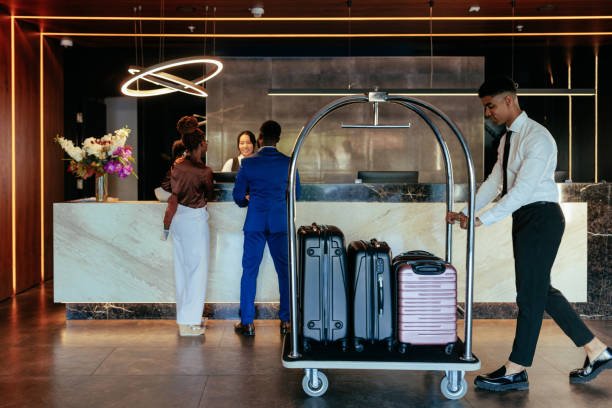
2.6 Bell Attendant
Bell attendants help guests with luggage and transportation arrangements.
Responsibilities can include:
- Carrying luggage
- Escorting guests to rooms
- Calling taxis
- Providing directions
- Explaining hotel facilities
The job requires physical strength and professional communication.
2.7 Hotel Maintenance Worker
Maintenance workers keep hotel facilities functioning properly.
They may handle:
- Minor repairs
- Plumbing problems
- Electrical maintenance
- Painting
- Equipment inspections
- General building maintenance
Although some entry-level maintenance jobs provide on-the-job training, technical skills can significantly improve employment prospects.
2.8 Kitchen Assistant
Kitchen assistants support cooks and chefs.
Their duties can include:
- Preparing ingredients
- Washing dishes
- Cleaning kitchen equipment
- Organizing supplies
- Assisting food preparation
These positions can provide a pathway toward professional culinary careers.
2.9 Dishwasher
Dishwashers clean:
- Plates
- Glasses
- Cooking equipment
- Kitchen utensils
This is generally an entry-level position.
However, it can be physically demanding, particularly in busy hotels and resorts.
2.10 Cook
Cooks prepare food according to hotel standards.
Depending on the position, they may prepare:
- Breakfast
- Lunch
- Dinner
- Desserts
- Banquet meals
Culinary qualifications and experience can improve earning potential.
2.11 Waiter or Food-Service Worker
Food-service employees work in hotel restaurants, bars, banquets, and room-service departments.
Responsibilities include:
- Taking orders
- Serving meals
- Preparing tables
- Communicating with guests
- Maintaining dining areas
Customer-service experience can help applicants compete for these roles.
2.12 Hotel Supervisor
Supervisory positions generally require experience.
Examples include:
- Housekeeping supervisor
- Front-office supervisor
- Food-service supervisor
- Maintenance supervisor
Supervisors coordinate employees and ensure that hotel standards remain consistent.
3. Hotel Salary Expectations in the USA
Salary varies significantly depending on:
- Location
- Job title
- Experience
- Employer
- Working hours
- Overtime
- Tips
- Seasonal demand
Therefore, African applicants should never assume that every hotel job pays the same amount.
Entry-level hospitality jobs may pay hourly wages close to the applicable local or state minimum wage, while specialized and supervisory positions can pay considerably more.
As a broad planning range, applicants may encounter positions around:
| Position | Approximate Annual Earnings |
|---|---|
| Housekeeper | $25,000–$40,000+ |
| Room Attendant | $25,000–$40,000+ |
| Laundry Attendant | $25,000–$38,000+ |
| Front Desk Agent | $28,000–$45,000+ |
| Bell Attendant | $25,000–$40,000+ |
| Kitchen Assistant | $25,000–$38,000+ |
| Cook | $30,000–$50,000+ |
| Maintenance Worker | $35,000–$55,000+ |
| Supervisor | $35,000–$60,000+ |
| Hotel Manager | $55,000–$100,000+ |
These figures are planning ranges rather than guaranteed salaries. Actual compensation can differ substantially by state, city, employer, experience, and benefits.
Additionally, tipped positions can have a different compensation structure.
Therefore, always read the actual job offer carefully.
4. States and Areas with Large Hospitality Industries
Hotel opportunities exist across the United States.
However, some locations have particularly large tourism and hospitality industries.
These include:
Florida
Florida attracts visitors because of its:
- Beaches
- Theme parks
- Resorts
- Warm climate
Therefore, hospitality employment is significant.
California
California has:
- Major cities
- Beaches
- Theme parks
- Wine regions
- National parks
Consequently, it supports a large hospitality workforce.
Nevada
Las Vegas is internationally known for:
- Hotels
- Resorts
- Casinos
- Conferences
- Entertainment
The hospitality industry plays a major role in the local economy.
New York
New York City attracts tourists, business travelers, and international visitors throughout the year.
Therefore, hotels employ large numbers of workers.
Hawaii
Tourism represents a major part of Hawaii’s economy.
However, applicants should consider the state’s high cost of living.
Colorado
Mountain resorts and tourism create hospitality employment, particularly during winter and summer seasons.
5. What Does “Visa Sponsorship” Mean?
This is one of the most important concepts for Africans searching for American jobs.
Visa sponsorship does not mean that an employer simply gives you a visa.
Instead, sponsorship generally means that an eligible U.S. employer agrees to support an immigration or temporary-worker process so that a foreign national can legally work in the United States.
Depending on the visa category, the employer may need to:
- Offer you employment.
- Complete required labor-related procedures.
- File a petition with U.S. immigration authorities.
- Provide documentation about the job.
- Support the worker through the relevant process.
Therefore, applicants should be extremely careful when an agent claims:
“Pay me and I will give you a U.S. work visa.”
No legitimate recruiter can simply sell you a U.S. work visa.
6. Can Hotels Sponsor African Workers?
Yes, some U.S. hospitality employers can sponsor foreign workers under appropriate immigration programs, but sponsorship is not available for every hotel position.
This distinction matters.
A hotel may advertise:
“Housekeeper needed.”
That does not automatically mean:
“Foreign workers outside the United States welcome.”
Consequently, Africans should specifically search for employers that participate in eligible temporary-worker programs or otherwise have a lawful immigration pathway available for the position.
7. The H-2B Visa for Temporary Hotel Workers
For many seasonal or temporary hospitality positions, the H-2B temporary nonagricultural worker program is particularly relevant.
Hotels and resorts can sometimes use this program when they have a temporary need for workers and satisfy the government’s requirements.
Potential hospitality occupations may include:
- Housekeepers
- Resort workers
- Hotel support workers
- Food-service workers
- Certain maintenance positions
However, employers must satisfy specific requirements before hiring foreign workers.
8. How the H-2B Process Works
The process generally begins with the employer—not the foreign worker.
This point is extremely important.
Step 1: Hotel Identifies a Temporary Labor Need
The employer determines that it has a temporary need for workers.
For example, a resort may require additional housekeeping staff during a busy tourism season.
Step 2: Employer Completes Required Labor Certification Process
The employer must complete the applicable Department of Labor process.
This generally involves demonstrating that hiring foreign workers will comply with the applicable labor requirements.
Step 3: Employer Files an Immigration Petition
After completing the required labor process, the employer generally files the relevant petition with U.S. Citizenship and Immigration Services.
The employer, rather than the foreign worker, normally initiates this petition.
Step 4: Worker Completes the Visa Process
After the petition and other requirements are satisfied, the worker can proceed with the appropriate visa application process through the U.S. consular system.
9. Step-by-Step H-2B Visa Application for Africans
Let’s examine the process more closely.
Step 1: Find a Legitimate Employer
Your first objective should be finding a genuine U.S. hotel or hospitality employer.
Do not begin by paying an agent.
Instead, verify:
- Employer identity
- Job title
- Location
- Wage
- Contract terms
- Visa category
Step 2: Receive a Genuine Job Offer
The employer should provide clear employment information.
Look for:
- Job duties
- Pay rate
- Start date
- Expected end date
- Working hours
- Accommodation information, if offered
Step 3: Employer Begins the Required Process
The employer handles the required labor certification and petition procedures.
You should not attempt to replace the employer in this process.
Step 4: Wait for Petition Processing
U.S. immigration authorities review the petition.
If approved, the employer can proceed with the next stage.
Step 5: Complete Your Visa Application
You may then need to complete the appropriate U.S. visa application and follow instructions from the U.S. embassy or consulate responsible for your location.
Step 6: Pay Applicable Fees
Pay official fees through authorized channels.
Be especially careful if a recruiter demands large “visa release” payments.
Step 7: Attend Your Interview
You may need to attend a consular interview.
The officer may ask:
- What job will you perform?
- Who is your employer?
- Where will you work?
- How long will you work?
- What is your salary?
- What will you do after the temporary employment ends?
Answer honestly.
Step 8: Provide Biometrics or Additional Information
Depending on the application process, you may need to provide fingerprints, photographs, or other information.
Step 9: Receive the Decision
If the application succeeds, you can make travel arrangements according to the visa and employment conditions.
10. Important Point About H-2B Visas
The H-2B program is temporary.
It does not automatically give you:
- Permanent residence
- U.S. citizenship
- Unlimited employment rights
Instead, the visa is tied to the approved temporary employment.
Therefore, applicants should understand the conditions before traveling.
11. Other Possible Visa Categories
Hotel employment can involve other immigration categories depending on the position and circumstances.
For example, highly specialized hotel management professionals may qualify for completely different immigration pathways.
However, Africans should not assume that every hotel position qualifies.
The correct visa depends on:
- Job duties
- Qualifications
- Employer
- Temporary or permanent need
- Immigration category
- Individual circumstances
Therefore, always verify the specific category before making financial commitments.
12. Do You Need a University Degree for Hotel Work?
Usually, not for many entry-level positions.
For example, employers may hire housekeepers, laundry attendants, kitchen assistants, and certain food-service workers without university degrees.
However, qualifications become increasingly important for specialized positions.
For example:
Hotel Manager
Employers may prefer:
- Hospitality degree
- Business degree
- Management experience
Chef
Employers may prefer:
- Culinary qualifications
- Professional experience
Maintenance Technician
Employers may require:
- Technical training
- Certifications
- Relevant experience
Therefore, education requirements depend heavily on the position.
13. English Language Requirements
English plays an important role in American hospitality.
You should be able to:
- Understand workplace instructions
- Communicate with supervisors
- Communicate with guests
- Follow safety procedures
However, requirements vary by employer.
For back-of-house positions, basic workplace English may be sufficient.
For front-desk roles, stronger communication skills become much more important.
READ: Sydney vs Melbourne: Where Does a $160,000 AUD Tech Salary Go Further in 2026?
14. Documents African Applicants Should Prepare
Prepare your documents early.
Common documents may include:
- Valid passport
- CV/resume
- Employment records
- Educational certificates
- Professional certificates
- Police documentation where required
- Job offer
- Employment contract
- Visa application documents
Depending on the visa category, authorities may require additional documentation.
15. How to Write a Strong Hotel Job CV
Your CV should be clear and professional.
Include:
Personal Information
Provide:
- Name
- Contact details
- Email address
- Current location
Avoid unnecessary personal information.
Professional Summary
Write a short statement describing your experience.
For example:
“Hardworking hospitality professional with four years of experience in housekeeping, room preparation, sanitation, and guest-service support.”
Work Experience
List:
- Employer
- Position
- Dates
- Main responsibilities
Use action verbs.
Instead of:
“Cleaning rooms.”
Write:
“Maintained guest rooms according to established cleanliness and hygiene standards.”
This demonstrates professionalism.
16. How Africans Can Search for Sponsored Hotel Jobs
One of the biggest challenges is identifying genuine sponsorship opportunities.
Search using terms such as:
- “H-2B hotel jobs”
- “H-2B housekeeping jobs”
- “seasonal hotel jobs sponsorship”
- “H-2B resort jobs”
- “temporary hospitality workers”
However, do not assume that every search result represents a legitimate sponsor.
Always verify the employer.
17. Use Official Sources
When searching for American employment, prioritize official sources.
Useful resources include:
- U.S. government immigration information
- U.S. Department of Labor resources
- Official employer career pages
- State employment resources
For immigration rules, use official government sources rather than social media posts.
18. Beware of Hotel Job Scams
Unfortunately, scammers target Africans who want to work abroad.
A fake recruiter may claim:
“USA hotel job available. Pay $5,000 and receive visa.”
This should immediately raise suspicion.
Legitimate employment processes do not work that way.
19. Warning Signs of a Scam
Be careful when someone:
- Guarantees a visa
- Requests money through personal accounts
- Uses only WhatsApp
- Refuses to provide an employer name
- Offers unusually high salaries
- Provides fake-looking contracts
- Pressures you to pay immediately
- Claims to have “embassy connections”
Therefore, verify everything independently.
20. Accommodation and Housing
Some seasonal hotel employers may provide accommodation or housing arrangements, but this is not guaranteed.
Before accepting a job, ask:
- Is accommodation provided?
- Is it free?
- If not, how much does it cost?
- How many people share the accommodation?
- Is transportation provided?
- Are utilities included?
These details can significantly affect your actual earnings.
21. Taxes and Take-Home Pay
Another important consideration involves taxes.
Your gross salary is not necessarily the amount you receive in your bank account.
Depending on your circumstances, deductions can include:
- Federal taxes
- State taxes
- Social Security
- Medicare
- Other deductions
Therefore, calculate your expected net income, not just the advertised wage.
22. Cost of Living in the USA
The United States has a wide range of living costs.
Housing in New York City or San Francisco can cost far more than housing in a smaller city.
Therefore, a $35,000 salary can have very different purchasing power depending on location.
Before accepting an offer, investigate:
- Rent
- Transportation
- Food
- Health costs
- Utilities
- Taxes
23. Hotel Work Can Be Physically Demanding
Applicants should understand the reality.
Housekeeping, laundry, kitchen work, and maintenance can involve:
- Standing
- Walking
- Bending
- Lifting
- Repetitive movements
Therefore, physical preparation matters.
Do not accept a job simply because it promises a U.S. visa.
Make sure you understand the actual work.
24. Career Growth in the Hotel Industry
One major advantage of hospitality work is career progression.
For example:
Housekeeper → Senior Housekeeper → Housekeeping Supervisor → Executive Housekeeper
Another pathway:
Kitchen Assistant → Cook → Sous Chef → Executive Chef
Another:
Front Desk Agent → Front Desk Supervisor → Front Office Manager → Hotel Manager
Therefore, an entry-level position does not necessarily mean an entry-level career forever.
25. Advantages of Hotel Work in the USA
Hotel employment can provide several benefits.
International Experience
Working in America can strengthen your professional profile.
Income
American wages can provide significant earning opportunities compared with many local labor markets.
Career Development
Hospitality workers can develop transferable skills.
Networking
Hotels bring together professionals from many backgrounds.
Exposure to Global Standards
You can learn international hospitality procedures.
26. Challenges of Hotel Work
However, applicants should also understand the disadvantages.
Seasonal Employment
Some jobs may end when the season ends.
Irregular Hours
Hotels operate around the clock.
Physical Work
Housekeeping and kitchen positions can be demanding.
Cost of Living
Some tourism destinations are expensive.
Immigration Restrictions
Temporary visas come with conditions.
27. Can Hotel Workers Get Permanent Residency?
A temporary hotel visa does not automatically lead to a green card.
This is a crucial point.
Some people incorrectly believe:
“If I work in America for one year, I automatically become a permanent resident.”
That is not how U.S. immigration works.
Permanent residence requires a separate legal basis.
Possible routes can depend on:
- Employment-based immigration
- Family sponsorship
- Diversity Visa eligibility
- Other qualifying categories
Therefore, never rely on an agent who promises automatic permanent residency.
28. Can You Bring Your Family?
Some temporary work visas may allow eligible dependents to accompany the worker under the appropriate dependent status.
However, dependents’ rights can differ from the principal worker’s rights.
Therefore, if you are married or have children, research the dependent rules before accepting an offer.
29. Tips for Africans Applying From Nigeria, Ghana, Kenya, and Other Countries
Although immigration rules apply nationally, applicants should prepare carefully.
For Nigerian Applicants
Make sure your:
- Passport is valid
- Employment history is consistent
- Financial information is genuine
- Supporting documents are authentic
For Ghanaian Applicants
Maintain clear records of:
- Employment
- Education
- Travel history
- Identity documents
For Kenyan Applicants
Prepare your professional documents and verify every employer before paying any recruitment fee.
For Applicants From Other African Countries
The same principle applies:
Use genuine documents, verify employers, and follow the official visa process.
30. A Practical Application Strategy
Instead of applying randomly, use a structured strategy.
Month 1: Preparation
- Update your CV
- Obtain your passport
- Gather certificates
- Build hospitality experience
Month 2: Job Search
- Research hotels
- Search seasonal opportunities
- Apply consistently
- Verify employers
Month 3: Interviews
- Practice interviews
- Prepare references
- Review job responsibilities
Following Months
- Follow the employer’s immigration process
- Complete required forms
- Attend appointments
- Prepare for travel
This approach helps you remain organized.
31. Questions to Ask Before Accepting a Job
Before accepting an offer, ask:
- What is the employer’s legal name?
- Where is the hotel located?
- What is the hourly wage?
- How many hours will I work?
- Is overtime available?
- Is accommodation provided?
- Is transportation provided?
- What visa category will I use?
- Who handles the immigration petition?
- How long is the contract?
- What happens when the contract ends?
- Are there deductions from my salary?
These questions can prevent expensive mistakes.
32. What You Should Never Do
Never:
- Submit fake documents
- Lie during a visa interview
- Overstay a visa
- Work outside your authorization
- Pay unknown individuals for guaranteed visas
- Use a fake job offer
Immigration violations can have serious consequences.
33. Frequently Asked Questions
Can I get a hotel job in America without a degree?
Yes. Many entry-level hotel positions do not require a university degree. However, getting legal work authorization from outside the United States is a separate issue.
Can a U.S. hotel sponsor me from Africa?
Some employers may sponsor eligible temporary workers, particularly where an appropriate temporary-worker program applies. However, sponsorship is not available for every position.
Which visa is commonly associated with seasonal hotel work?
The H-2B program can be used by qualifying employers for temporary nonagricultural workers, including certain hospitality roles.
Do I need hotel experience?
Not always. Some entry-level jobs provide training. Nevertheless, experience can make you a stronger candidate.
Can I become a permanent resident through hotel work?
Not automatically. You would need to qualify through an independent immigration pathway.
How much can hotel workers earn?
Pay varies by occupation, location, employer, experience, tips, and hours. Always evaluate the specific job offer rather than relying on general salary figures.
Can I bring my spouse and children?
Depending on the visa category, eligible dependents may have a corresponding dependent status. Check the specific rules before making plans.
34. Final Advice for African Job Seekers
If you are serious about working in the American hospitality industry, focus on three things:
First: Build Employable Skills
Improve:
- English
- Customer service
- Housekeeping
- Cooking
- Maintenance
- Hospitality management
Second: Find Genuine Employers
Do not depend entirely on random social media advertisements.
Third: Understand Immigration
A job offer and a visa are two different things.
You need both:
A legitimate employment opportunity + a valid immigration pathway.
Conclusion
Hotel worker jobs in the United States can provide valuable opportunities for Africans who want to build international work experience. The hospitality industry employs people in many different roles, including housekeeping, room service, kitchen operations, maintenance, front-desk services, food service, and management.
However, applicants must approach the opportunity realistically.
The most important lesson is that not every hotel job comes with visa sponsorship. Furthermore, a temporary hospitality job does not automatically provide permanent residency.
For certain seasonal hospitality positions, the H-2B program can provide an important legal pathway when a qualifying U.S. employer demonstrates a temporary need and completes the required government procedures. Nevertheless, applicants must follow the official process and should never rely on agents who promise guaranteed visas.
Therefore, if you are an African looking for hotel employment in America, start by developing relevant skills, preparing a professional CV, researching legitimate employers, verifying every job offer, and learning the immigration requirements that apply to your particular situation.
Most importantly, never pay someone simply because they promise you a U.S. visa. A legitimate employer and a legitimate immigration process should be verifiable.
With patience, preparation, and careful research, hospitality work can become an important step toward building international experience and developing a long-term career. The journey may take time, but making informed decisions from the beginning can protect your money, your immigration status, and your future.